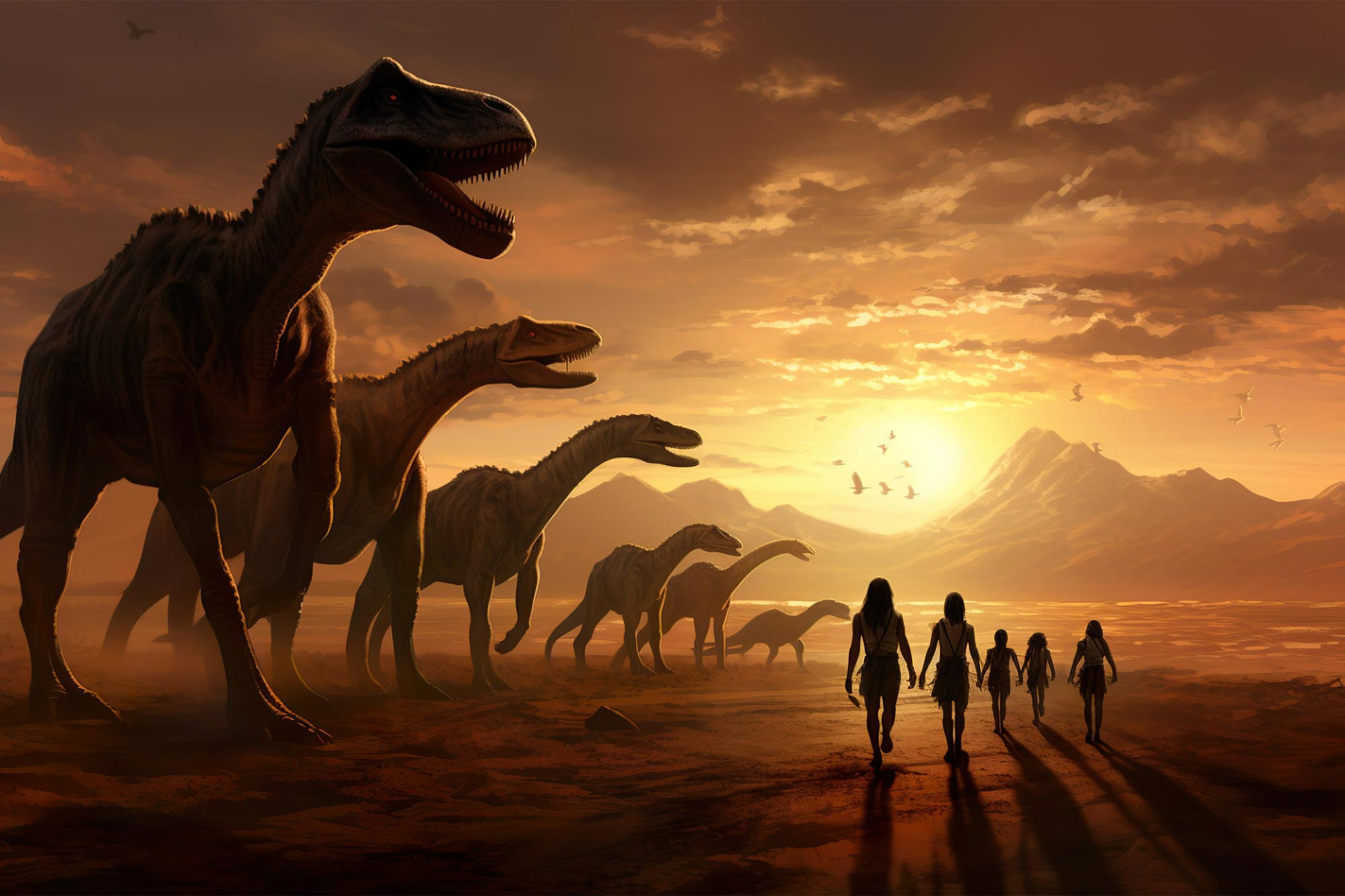


브리스톨 대학과 프리부르 대학의 연구자들이 화석 기록을 심층적으로 분석한 결과 인간, 개, 박쥐 등의 종을 포함하는 태반류 포유류가 백악기에 잠시 공존하면서 진화한 것으로 나타났습니다. 멸종 직전의 공룡들. (이 예술가의 묘사와는 달리, 초기 태반 포유류는 아기 다람쥐와 닮았다고 생각됩니다.)
ㅏ[{” attribute=””>Cretaceous origin for placental mammals, the group that includes humans, dogs, and bats, has been revealed by in-depth analysis of the fossil record, showing they co-existed with dinosaurs for a short time before the dinosaurs went extinct.
The catastrophic destruction triggered by the asteroid hitting the Earth resulted in the death of all non-avian dinosaurs in an event termed the Cretaceous-Paleogene (K-Pg) mass extinction. Debate has long raged among researchers over whether placental mammals were present alongside the dinosaurs before the mass extinction, or whether they only evolved after the dinosaurs were done away with.
Fossils of placental mammals are only found in rocks younger than 66 million years old, which is when the asteroid hit Earth, suggesting that the group evolved after the mass extinction. However, molecular data has long suggested an older age for placental mammals.
In a new paper published in the journal Current Biology, a team of palaeobiologists from the University of Bristol and the University of Fribourg used statistical analysis of the fossil record to determine that placental mammals originated before the mass extinction, meaning they co-existed with dinosaurs for a short time. However, it was only after the asteroid impact that modern lineages of placental mammals began to evolve, suggesting that they were better able to diversify once the dinosaurs were gone.
The researchers collected extensive fossil data from placental mammal groups extending all the way back to the mass extinction 66 million years ago.
Lead author Emily Carlisle of Bristol’s School of Earth Sciences said: “We pulled together thousands of fossils of placental mammals and were able to see the patterns of origination and extinction of the different groups. Based on this, we could estimate when placental mammals evolved.”
Co-author Daniele Silvestro (University of Fribourg) explained: “The model we used estimates origination ages based on when lineages first appear in the fossil record and the pattern of species diversity through time for the lineage. It can also estimate extinction ages based on last appearances when the group is extinct.”
Co-author Professor Phil Donoghue, also from Bristol, added: “By examining both origins and extinctions, we can more clearly see the impact of events such as the K-Pg mass extinction or the Paleocene-Eocene Thermal Maximum (PETM).”
Primates, the group that includes the human lineage, as well as Lagomorpha (rabbits and hares) and Carnivora (dogs and cats) were shown to have evolved just before the K-Pg mass extinction, which means our ancestors were mingling with dinosaurs. After they survived the asteroid impact, placental mammals rapidly diversified, perhaps spurred on by the loss of competition from the dinosaurs.
Reference: “A timescale for placental mammal diversification based on Bayesian modeling of the fossil record” by Emily Carlisle, Christine M. Janis, Davide Pisani, Philip C.J. Donoghue and Daniele Silvestro, 27 June 2023, Current Biology.
DOI: 10.1016/j.cub.2023.06.016
This work was carried out using the computational facilities of the Advanced Computing Research Centre, University of Bristol.

“요은 베이컨과 알코올에 대한 전문 지식을 가진 닌자입니다. 그의 탐험적인 성격은 다양한 경험을 통해 대중 문화에 대한 깊은 애정과 지식을 얻게 해주었습니다. 그는 자랑스러운 탐험가로서, 새로운 문화와 경험을 적극적으로 탐구하며, 대중 문화에 대한 그의 열정은 그의 작품 속에서도 느낄 수 있습니다.”