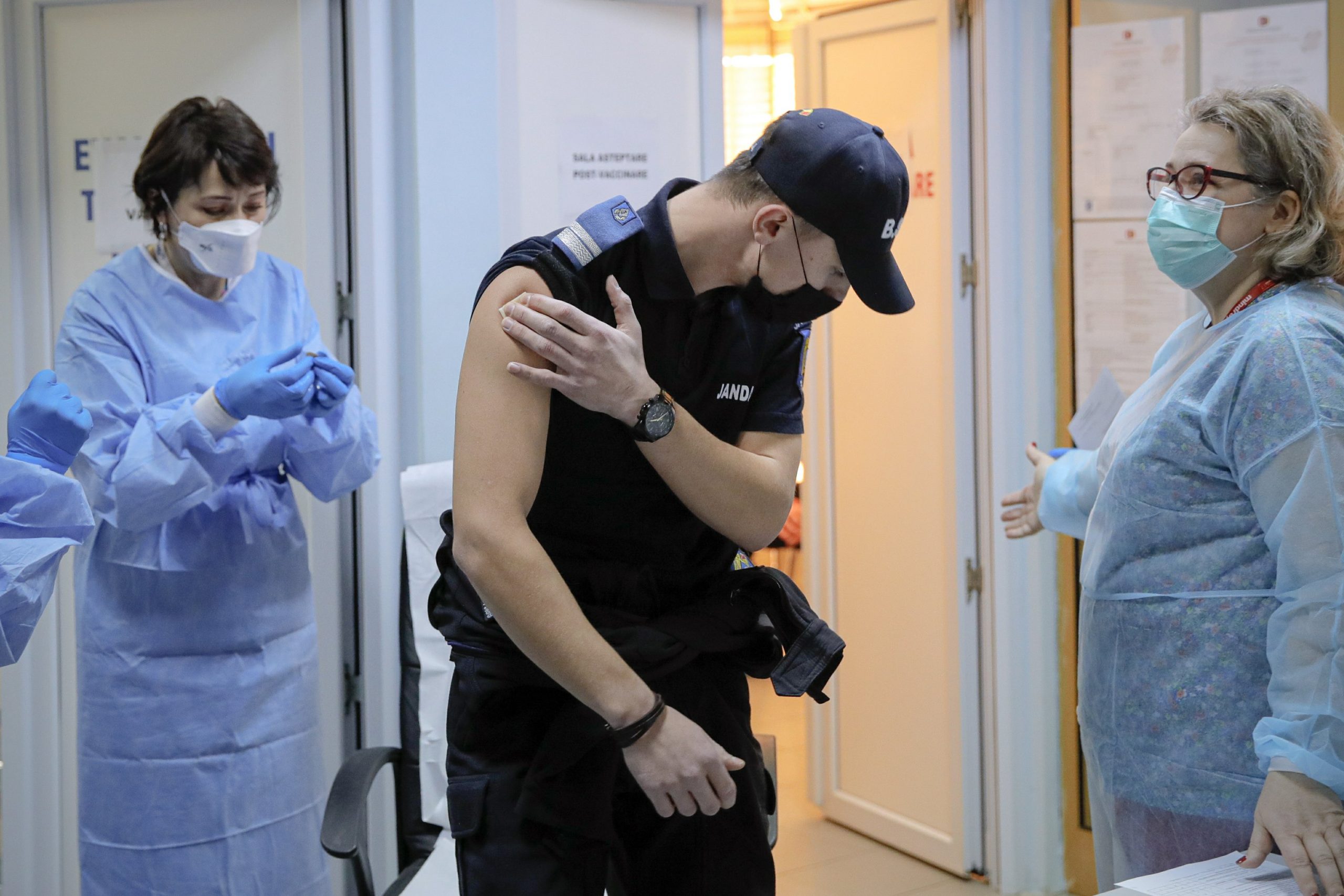

Belgrade, Serbia (AP) – Vaccines from the West, Russia or China? Or nothing at all? Countries in southeastern Europe face this dilemma, where vaccination campaigns against the Coronavirus have a slow start – overshadowed by heated political debate and conspiracy theories.
In countries such as the Czech Republic, Serbia, Bosnia, Romania and Bulgaria, vaccine skeptics have included former presidents and even some doctors. Serbian tennis champion Novak Djokovic was among those who said he did not want to be vaccinated.
False beliefs that the coronavirus is a hoax or that vaccines would inject microchips into people in countries that were previously under harsh communist rule have spread. Those who routinely undergo mass vaccination are deeply divided over whether or not to get vaccinated.
A recent study in the Balkans warned of a direct link between support for conspiracy theories and skepticism about vaccination. “The majority across the region are not planning to get the vaccine, which is a much smaller percentage than anywhere else in Europe, where the majority prefer to be vaccinated.”
Only about 200,000 people applied to get the vaccine in Serbia, a country of 7 million, in the days after the authorities began the procedure. By contrast, 1 million Serbs signed up for 100 euros ($ 120) on the first day the government offered to help the epidemics.
Hoping to encourage vaccination, Serbian officials have filmed their footage on television. However, they themselves have been divided over whether to acquire the Western-made Pfizer-BioNTech vaccine or Russia’s Sputnik V, a further division in a country that is officially seeking EU membership but many prefer closer ties with Moscow.
On Saturday, Serbian President Aleksandar Vucic received a shipment of one million doses of the Chinese Sinopharm vaccine, saying he would receive an injection to prove it was safe.
“Serbs prefer the Russian vaccine,” as stated in the recent headline of Informer, a popular pro-government newspaper, where officials announced that 38% of those who applied to be vaccinated preferred the Russian vaccine, while 31% of Pfizer-BioNTech wanted the release – an approximate split between Pro-Russians and pro-Westerns in Serbia.
In neighboring Bosnia, a war-torn country still ethnically divided between Serbs, Bosniaks and Croats, politics is also a factor, with the half run by Serbs appearing to be ready to choose a Russian vaccine, while the Bosnian-Croat part is likely to shift west.
Sasa Milovanovic, a 57-year-old real estate agent from Belgrade, sees all vaccines as part of the “global manipulation” of the epidemic.
He said, “People are locked up, they no longer have life, and they live in a state of hysteria and fear.”
Djokovic has said he opposes being forced to take a coronavirus vaccine in order to travel and compete but has been keeping his mind open. The highest-rated tennis player and his wife tested positive in June after a series of exhibition matches without any social distancing organized in the Balkans. Together with their foundation, they donated one million euros ($ 1.1 million) to purchase ventilators and other medical equipment for hospitals in Serbia.
The Serbian Ministry of Health official Mirsad Gerlik described the vaccine response as “satisfactory”, but warned on the state-run RTS radio that “people in rural areas usually believe in conspiracy theories, which is why we must talk to them and make clear that the vaccine is the only way out in this case.” “.
A study by the European Balkan Policy Advisory Group, published before the start of the regional vaccination campaign in December, concluded that virus conspiracy theories are believed by nearly 80% of citizens of Western Balkan countries striving to join the European Union. And she said that about half of them would refuse to be vaccinated.
Unfounded theories claim the virus is not real or that it is a biological weapon created by the United States or its adversaries. Another common lie is that Microsoft founder Bill Gates is using COVID-19 vaccines to implant microchips in 7 billion people on the planet.
The low level of information about the virus and vaccines, distrust of governments, and repeated assertions by authorities that their countries are being besieged by foreigners help explain the high prevalence of such beliefs, according to the Balkan Research Center.
Similar trends are observed even in some eastern European Union countries.
In Bulgaria, widespread conspiracy theories hindered previous efforts to deal with a measles outbreak. Surveys indicate that mistrust of vaccines remains high even as coronavirus cases continue to rise. A recent Gallup International Poll showed that 30% of respondents want to be vaccinated, 46% will refuse and 24% remain undecided.
Bulgarian doctors tried to change positions. Dr Stefan Konstantinov, former Minister of Health, joked that people should be told that neighboring Greece will close tourist resorts to tourists who are not vaccinated, because “this will ensure that about 70% of the population will rush to get an injection.”
In the Czech Republic, where surveys showed that 40% reject vaccination, protesters in a major rally against the government’s anti-virus restrictions in Prague demanded that vaccinations not be required. Former President Vaclav Klaus, a staunch critic of the government’s response to the pandemic, told the crowd that vaccines are not a solution.
“They say everything will be solved with a miracle vaccine,” Klaus, 79, insists that people must be exposed to the virus to acquire immunity, which experts reject. “We have to say loud and clear that there is no such thing … I will not receive the vaccination.”
Populist authorities in Hungary have taken a hard-line stance against disinformation regarding the virus, but vaccine refusals are still expected to be around 30%. Parliament passed emergency powers in March, which allow authorities to prosecute anyone believed to “dampen a successful defense” against the virus, including “creating fear” or spreading false news. At least two people have been arrested who have criticized the government’s response to the pandemic on social media, but neither has been officially charged.
Romanian Health Minister Vlad Vojkulescu said he relied on family doctors to “inform, schedule and monitor people after vaccination” and that his ministry would offer bonuses to medical workers based on the number of people on board. In response to a question about whether these incentives will feed anti-vaccination propaganda, Voiculescu said: “I am more interested in seeing doctors on this issue than I do with anti-vaccination activists.”
Ivica Jeremiمي, who has worked with HIV patients in Serbia since March and tested positive for the virus in November, hopes that vaccination programs will speed up once people overcome their fear of the unknown.
“People will realize that the vaccine is the only way to return to normal life,” he said.
___
Associated Press book by Veslin Tuchkov in Sofia, Bulgaria; Karel Janicek in Prague, Czech Republic; Justin Spike in Budapest, Hungary; And Vadim Gerda from Bucharest, Romania, contributed to it.
—–
Follow AP’s coverage of the coronavirus pandemic at:
https://apnews.com/hub/coronavirus-pandemic
https://apnews.com/hub/coronavirus-vaccine
https://apnews.com/UnderstandingtheOutbreak

“동민은 커피에 대한 깊은 지식을 갖춘 전문가로, 다양한 커피 블렌드와 추출 방식에 대한 연구를 해왔습니다. 게임 세계에서도 그의 이름은 잘 알려져 있으며, 그의 취향은 다양한 게임 장르를 아우릅니다. 알코올과 특히 베이컨에 대한 그의 열정은 독특하며, 다양한 행사와 이벤트의 주최자로서 그의 통찰력은 뛰어납니다.”