


© Provided by Quartz
The ability to adapt to changing environments has deep roots. In a technology-led world, people tend to combine resilience with technological change, especially when it comes to navigating in adverse climates and places. But not every technological revolution is the result of environmental change.
At times, existing toolkits – containing, for example, simple chunks and scraping chips – allowed early humans to exploit new resources and flourish under changing conditions. As a species, humans also have the ability to use disrupted environments quickly. And as new research conducted in Olduvai Gorge in Tanzania showed, this adaptive capacity was already evident millions of years ago.
Our New studyPublished in Nature Communications, it is the product of a real team and multidisciplinary effort. Lead investigators from Canada and Tanzania worked with partners in Africa, North America, and Europe to describe a wide range of stone tools, fossil bones, and chemical agents from dental and plant materials. We also examined microscopic fractions of silica left by plants, ancient pollen, and airborne charcoal from natural fires recovered from ancient river bed and lake outcrops in the Serengeti plains.
Taken together, the data we collected provide the first evidence of human activity in the Olduvai Gorge: about two million years ago. It also shows that early humans used a great variety of habitats as they adapted to constant change.
East Africa is among the major regions in the world for human origins research. It boasts extraordinary records of extinct species spanning millions of years. For more than a century, ancient anthropologists have explored sedimentary outcrops and hominin fossils in surveys and excavations. But the relationship between these fossils and their environmental context remains elusive. This is because there are not many ancient datasets directly related to the cultural remains left by the extinct early humans. Our a study An important step in bridging this gap.
Miscellaneous artifacts and data
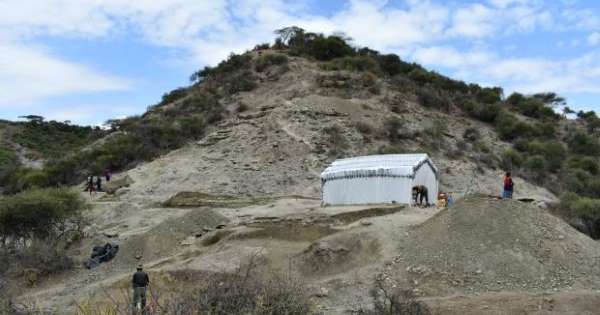
The data set was acquired during a recent survey of the undiscovered western portion of the ancient basin. The area is called Iwas Olduba. In the Maa language spoken by the locals, this means “road to the gorge”. It’s a fitting name: the site extends over the path connecting the rim of the valley to its bottom. Here, an exposed canyon wall reveals two million years of history.
The team worked closely with Masai scholars and communities when excavating the site. The research group recruited a large group of participants, male and female, who were chosen from the local community. In addition to Communicate with the community in the national languageIn Swahili, we offer university education opportunities for two Maasai scholars interested in archeology and heritage, along with many other Tanzanians.
The discovered stone tools belong to the “culture” that archaeologists know as Oldowan. This is a landmark that represents early humans who interacted with their environment in new ways, for example, through food innovations combining meat and plants. In East Africa, Oldowan began about 2.6 million years ago.
The concentration of stone tools and animal fossils is evidence that humans and animals gathered around the water sources. We also learned that Oldowan hominins extensively cast their web for resources. Our data reveal that early humans carried rocks with them for tools they obtained from sources far across the basin, 12 kilometers east. They also developed flexibility in using different variable environments.
Our research reveals that the geological, sedimentary and botanical landscapes around Ewass Oldupa have changed a lot and rapidly. However, humans have continued to return here to use local resources for more than 200,000 years. They used a variety of habitats: fern meadows, forest mosaics, naturally burnt landscapes, palm groves on the banks of the lake, steppes. These habitats have been systematically covered with ash or reworked by mass flows associated with volcanic eruptions.
Thanks to previous and ongoing radiometric work – using the Argonne method, which determines the date of deposition of volcanic material that confines archaeological finds – we were able to date these artifacts to a period known as the Early Ice Age, two million years ago.
What is not clear are the types of hominins that made the tools. We did not recover hominin fossils, but remnants to turn down It was found in newer sediments from another location only 350 meters away. It may be to turn down Or a member of the sex Paranthropus –Remains of them were found in the Olduvai Gorge earlier – he was the maker of tools. More research will be needed to confirm.
Cooperat
One of the reasons this research is so important is that it shows, once again, the value of collaboration. Archaeologists, earth scientists, biologists, chemists and materials scientists participated in the study at Ewass Oldupa.
Thanks to the multiple samples and artifacts that these experts collected and analyzed, we also now know that adaptation to major geomorphological and environmental shifts had no effect on the technology used in hominins. They roamed many habitats but only used one set of tools, among unexpected environments.
This is a clear sign that humans two million years ago were not technologically constrained and already had the capacity to expand geographically, as they were willing to exploit many habitats within – and perhaps even outside – Africa.
Julio Mercader Florin, professor, University of Calgary
This article was republished from Conversation Under a Creative Commons license. Read the The original article.

“요은 베이컨과 알코올에 대한 전문 지식을 가진 닌자입니다. 그의 탐험적인 성격은 다양한 경험을 통해 대중 문화에 대한 깊은 애정과 지식을 얻게 해주었습니다. 그는 자랑스러운 탐험가로서, 새로운 문화와 경험을 적극적으로 탐구하며, 대중 문화에 대한 그의 열정은 그의 작품 속에서도 느낄 수 있습니다.”